
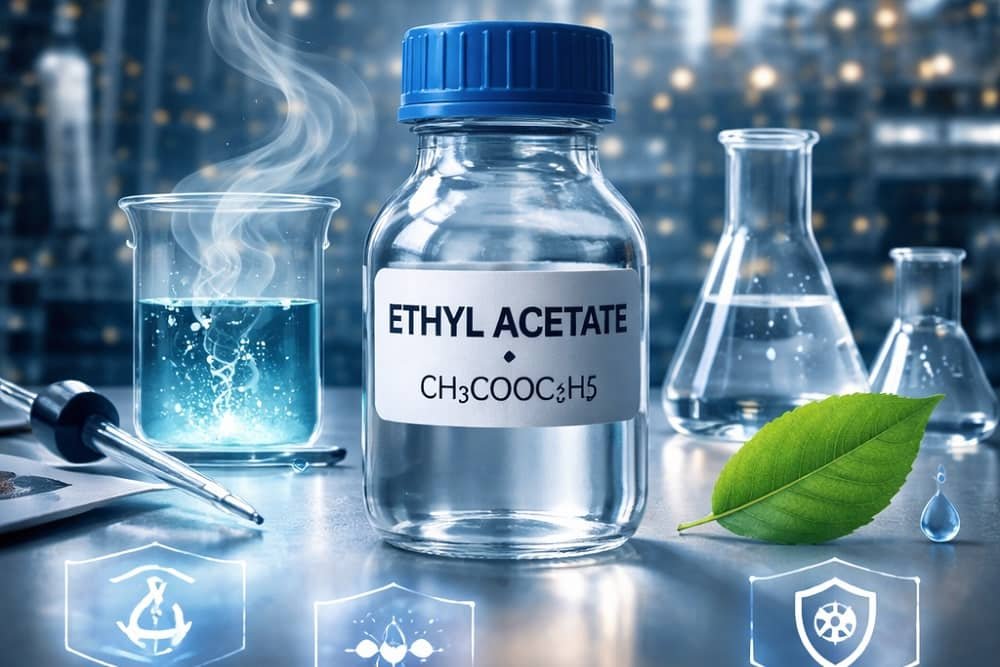
Ethyl Acetate – What Is It?
Most chemical plants don’t use fancy or complex materials to get their work done. They use simple, practical ones. These materials need to dissolve things well, dry at the right speed, and work the same way every time.
One such material is Ethyl Acetate. You can find it in storage tanks across many different industries. Coating plants use it. Printing ink plants use it. Pharmacists use it too.
But why is it so popular? The answer is simple: balance. It sits right in the middle — not too strong, not too weak.
It dissolves many materials without damaging equipment. It dries quickly but not too fast. That’s what makes it so useful.
Basic Chemical Facts
Ethyl Acetate belongs to a group of chemicals called esters. An ester forms when an alcohol mixes with an acid. In this case, two simple chemicals — ethanol and acetic acid — combine. Water is released, and the ester is created.
The molecule is quite small. It only has four carbon atoms. But its special middle part — called an ester linkage — controls how it behaves.
Here are some basic facts about it:
- Formula: C₄H₈O₂
- Weight:11 g/mol
- Boiling point: about 77°C
- Melting point: about −84°C
- Density: close to 0.90 g/cm³
- Appearance: clear liquid
It has a light, fruity smell. That’s because similar chemicals occur naturally in fruits. However, scientists in factories care less about the smell. They care more about how fast it dries, how well it dissolves things, and how it works with other materials.
Why Does It Work So Well?
The secret lies in its structure.
It has moderate polarity. Think of polarity like a magnet. Very polar solvents dissolve things like salt. Non-polar solvents dissolve things like oil.
Ethyl Acetate sits in the middle, so it can dissolve many different materials.
It mixes well with organic materials. Resins, pigments, oils, and plastics all mix well with it. This means one solvent can be used for many different products.
It flows easily. It is not thick. This helps it mix quickly inside large tanks.
It dries at just the right speed. Not too fast, not too slow. This makes it safe to work with while still being useful in factories.
How Is It Made?
Making Ethyl Acetate on a large scale is straightforward. Factories use one of two main methods.
Method 1: The Traditional Way
- Ethanol and acetic acid are put into a reactor
- A catalyst (a helper chemical) speeds up the reaction
- Water is produced as a by-product
- The mixture is then separated using distillation (a heating and cooling process)
Method 2: Using Acetaldehyde Two molecules of a chemical called acetaldehyde are joined together using a metal catalyst. This directly produces Ethyl Acetate. Some large factories prefer this method.
After production, the chemical is cleaned up. Water, leftover acid, and alcohol are removed. This makes sure it is pure enough to use in factories and labs.
Use in Chemical Processing
Sometimes a chemical needs to be dissolved, but water won’t work and oil won’t work either. Ethyl Acetate steps in and does the job.
It is also used to separate chemicals. Because it doesn’t fully mix with water, it can pull certain materials out of a water mixture.
Research labs often use it when testing new chemical reactions for the first time.
Use in Paints and Coatings
Paint factories use large amounts of solvent. The solvent helps dissolve resins (the sticky part of paint), control thickness, and help the paint dry properly.
Ethyl Acetate works well with many common resins used in paints. When paint is applied to a surface, the solvent spreads the resin out. Then the solvent evaporates, leaving a smooth, hard film behind.
Its drying speed fits well with spray guns, brushes, and roller machines used in factories.
Use in Glues and Packaging
Glue makers also use Ethyl Acetate. It keeps the glue liquid while it is being applied. Once spread, the solvent evaporates and leaves a strong bond behind.
You can find it in:
- Glues for flexible packaging
- Rubber-based adhesives
- Paper lamination products
Its fast drying speed helps packaging factories work quickly.
Use in Printing Inks
Printing machines that print on packaging materials use solvent-based inks. These inks need to flow smoothly through machines and dry fast on surfaces.
Ethyl Acetate helps by:
- Dissolving the resin in the ink
- Controlling how thick the ink is
- Helping the ink dry quickly
It is also helpful because it doesn’t leave a strong smell behind — which is very important for food packaging.
Use in Medicine and Labs
In pharmaceutical factories and chemistry labs, picking the right solvent is very important.
Ethyl Acetate is used to:
- Extract drug compounds from mixtures (pull out the useful part)
- Purify compounds by letting them crystallize as the solvent dries
- Run experiments like chromatography (a method to separate mixtures)
Compared to many other industrial solvents, it is relatively easier and safer to handle.
Use in Food and Flavors
Ethyl Acetate occurs naturally in fruits. Because of this, small amounts are used in the food industry to extract natural flavors from plants.
It can be used in:
- Natural flavor extraction
- Processing tea or coffee
- Making flavor ingredients
Health and safety authorities keep a close watch on how much is allowed in food products.
Safety and Storage
Ethyl Acetate is fairly safe compared to many industrial chemicals. But it still needs to be handled carefully.
It is flammable, so storage areas need good airflow and no open flames.
Workers who use it should wear:
- Protective gloves
- Eye protection
- Work in well-ventilated areas
Breathing in too much vapor can cause irritation or dizziness. Factories have ventilation and monitoring systems to prevent this.
Protecting the Environment
When large amounts of solvent are used, some vapor escapes into the air. Modern factories use vapor recovery systems to catch these vapors and return them to storage tanks.
Waste liquid containing Ethyl Acetate can also be cleaned and reused through distillation. This saves money and reduces pollution. These practices are now common in coating plants and pharmaceutical factories.
Supply and Demand
As manufacturing grows around the world, the demand for good solvents keeps rising. Coatings, flexible packaging, and pharmaceutical industries all need large amounts.
Chemical suppliers play an important role in making sure factories receive pure, reliable solvent. Without consistent quality, many products could not be made properly.
Why Is It Better Than Other Solvents?
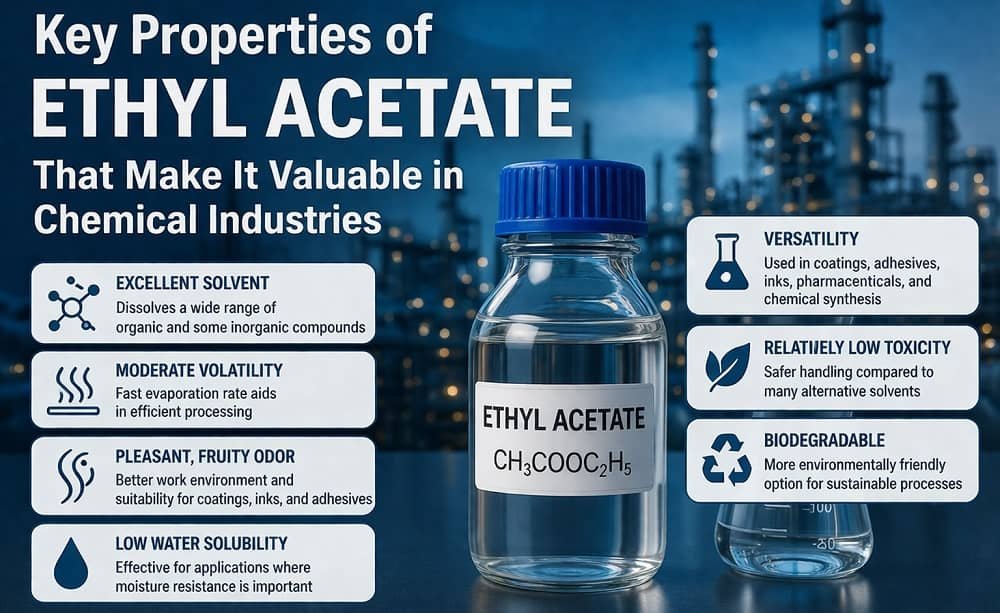
Here’s a quick summary of why Ethyl Acetate is so popular:
- ✅ Dissolves many different materials
- ✅ Dries at a useful speed — not too fast, not too slow
- ✅ Safer to handle than many stronger solvents
- ✅ Works in many different industries
What About the Future?
Scientists are always looking for better and greener ways to make chemicals.
Ethyl Acetate could be made in a more eco-friendly way in the future. Ethanol from fermentation (like how bread dough rises) could be used to make it from renewable sources.
Packaging industries are growing fast around the world. They still rely heavily on solvents like Ethyl Acetate. So demand is expected to stay strong for many years.
Final Thought
The most useful things in chemistry are often the quiet ones. They just keep working, day after day, without any drama.
Ethyl Acetate is exactly like that. It dissolves things well. It dries at the right speed. It works in many industries. It’s not flashy — but it gets the job done.
That’s why it remains one of the most practical and widely used solvents in modern industry.

