
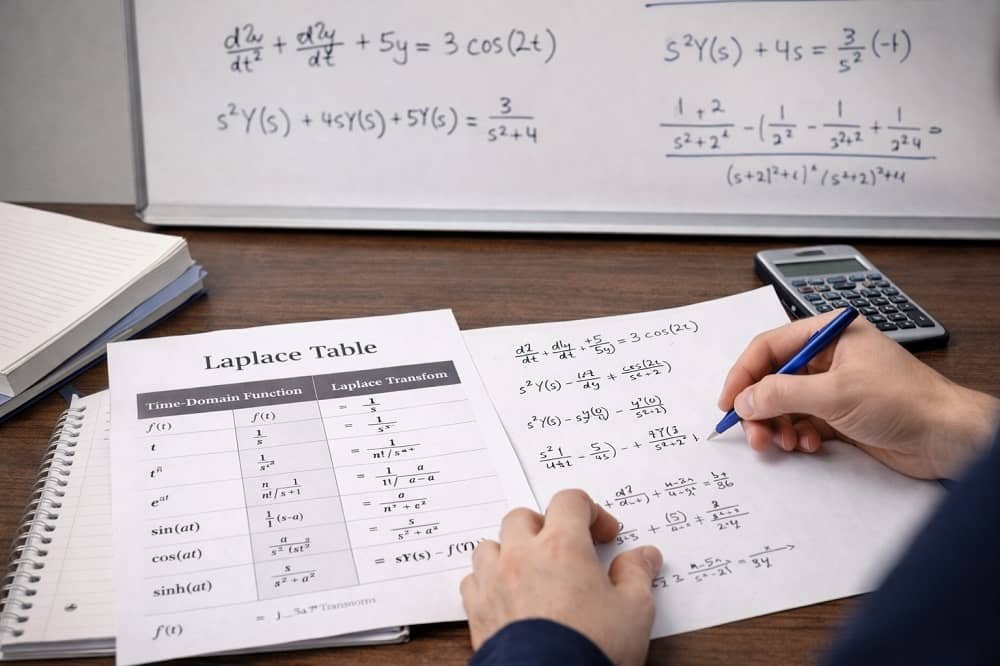
If you’re an engineering student, applied mathematician, or professional working with differential equations, you’ve likely encountered the term laplace table. This tool is a cornerstone of mathematical analysis, particularly in fields where systems are modeled with differential equations. Rather than computing Laplace transforms from scratch using integrals, specialists rely on a structured laplace table to convert functions from time domain to frequency domain and back again with speed and reliability.
A laplace table isn’t just a chart of formulas—it’s a powerful shortcut that simplifies complex calculus into algebraic manipulation. In this comprehensive guide, we’ll explore what a laplace table is, how it’s constructed, how it relates to the laplace transform table and the inverse laplace transform table, and the wide range of applications that make it indispensable in engineering, physics, and beyond.
By the end of this article, you’ll be able to read, use, and apply the laplace table effectively—whether for homework, exams, or real-world problem solving.
What Is a Laplace Table?
A laplace table is a reference chart that lists common time-domain functions alongside their corresponding Laplace transform expressions in the complex s-domain. Instead of performing integration every time you need to find a Laplace transform, you can simply look up the transform in the table.
Featured Snippet Definition
A laplace table is a reference chart that maps functions in the time domain to their Laplace transform in the s-domain, allowing fast transformation without computing complex integrals every time.
Laplace tables typically include a forward transform section (the laplace transform table) and an inverse section (the inverse laplace transform table) for converting back from the s-domain to the time domain.
Why Use a Laplace Table?
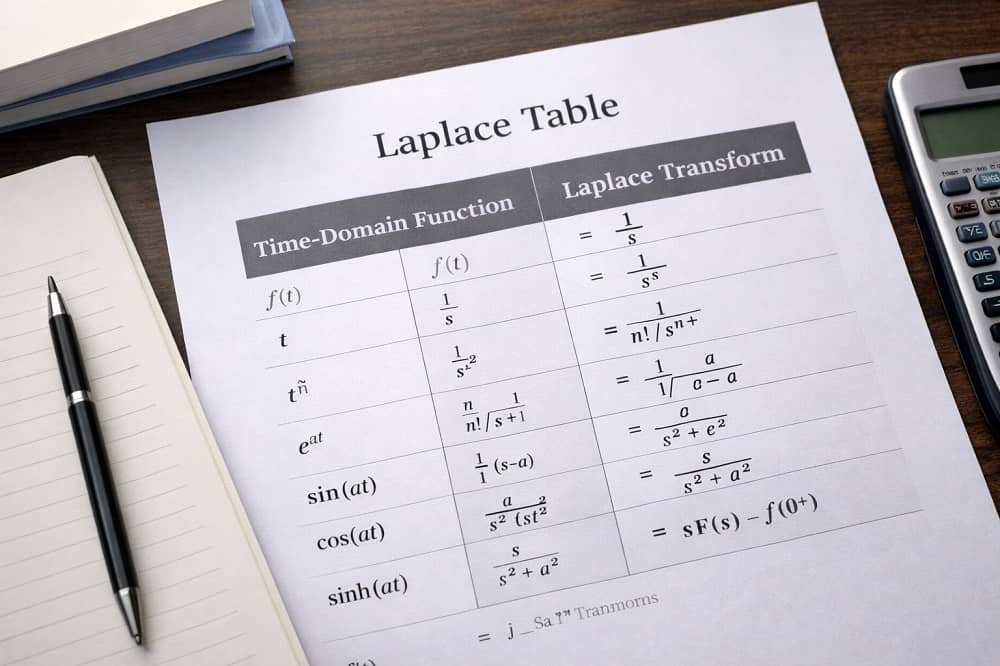
The laplace table is essential because the Laplace transform itself is defined by an integral:
$$
\mathcal{L}\{f(t)\} = \int_{0}^{\infty} e^{-st} f(t)\,dt
$$
Evaluating this integral directly can be tedious or impractical for many functions. By using a laplace table, you can:
- Save time on repetitive integration
- Avoid errors in manual calculations
- Solve differential equations by converting them into algebraic equations
- Analyze systems in control engineering and signal processing
- Work directly with transforms in real-world applications like circuits and mechanical systems
The table acts as a bridge between time-domain behavior and algebraic analysis in the s-domain.
Understanding the Laplace Transform
Before we dive into the table itself, it helps to understand the purpose of the Laplace transform.
The Laplace transform takes a function of time, f(t)f(t)f(t), and converts it into a function of s, a complex frequency variable:
\[
\mathcal{L}\{f(t)\} = F(s)
\]
Where s = σ + iω (a complex number). Transforming to this domain turns derivatives and integrals into simpler algebraic forms, which is particularly useful for solving linear differential equations.
For example, instead of solving a differential equation directly in time, you transform it using the laplace table, solve the resulting algebraic equation in s, and then convert back with the inverse laplace table.
The Standard Laplace Transform Table
A well-organized laplace table displays pairs of functions and their transforms. Below are some of the most commonly encountered entries you’ll see in a table of laplace transforms:
Basic Polynomial and Exponential Functions
- \[
\mathcal \ 1 \ → \frac{1}{s}
\] - \[
\mathcal \ t \ → \frac{1}{s^2}
\] - \[
\mathcal \ t^n \ → \frac{n!}{s^{n+1}}
\] - \[
\mathcal \ e^at \ → \frac{1}{s – a}
\]
Trigonometric Functions
- \[
\mathcal{L}\{\sin(at)\} = \frac{a}{s^2 + a^2}
\] - \[
\mathcal{L}\{\cos(at)\} = \frac{s}{s^2 + a^2}
\]
Special and Advanced Functions
- \[
\mathcal{L}\{e^{at}\sin(bt)\} = \frac{b}{(s – a)^2 + b^2}
\] - \[
\mathcal{L}\{e^{at}\cos(bt)\} = \frac{s – a}{(s – a)^2 + b^2}
\]
These entries form the backbone of a laplace table and are the most commonly used transforms in engineering and applied sciences.
Properties That Make the Laplace Table Powerful
The strength of a laplace table comes not only from listing transform pairs, but also from how those pairs interact through transform properties like:
Linearity
\[
\mathcal{L}\{a f(t) + b g(t)\} = aF(s) + bG(s)
\]
Shifting
\[
\mathcal{L}\{e^{at} f(t)\} = F(s – a)
\]
Scaling and Time Multiplication
- Scaling time or multiplying by powers of t has direct implications on the transform expression.
These properties let you generate new transforms by combining and modifying entries in your laplace table.
What Is an Inverse Laplace Transform Table?
Once you’ve solved a problem in the s-domain, you often need to convert back to the time domain. That’s where the inverse laplace transform table becomes essential.
If the Laplace transform maps f(t)f(t)f(t) to F(s)F(s)F(s), then:
\[
\mathcal{L}^{-1}\{F(s)\} = f(t)
\]
The inverse laplace table lists functions in s alongside their corresponding time-domain counterparts. For example:
- \[
\mathcal{L}^{-1}\left\{\frac{1}{s}\right\} = 1
\] - \[
\mathcal{L}^{-1}\left\{\frac{1}{s-a}\right\} = e^{at}
\] - \[
\mathcal{L}^{-1}\left\{\frac{a}{s^2 + a^2}\right\} = \sin(at)
\]
Instead of performing complex contour integration, you simply match the s-domain expression to an entry in the table to get the original function.
Laplace Table vs Inverse Laplace Table
| Feature | Laplace Table | Inverse Laplace Table |
| Direction | Time
s |
s
Time |
| Purpose | Find transform of a function | Find original function from transform |
| Use Case | Setup and solve problems | Interpret final solutions |
| Example | \[ t \rightarrow 1/s \] |
\[ 1/(s – a) \rightarrow e^{at} \] |
Both sections are essential, and advanced references often combine them into a single laplace table for convenience.
How to Use a Laplace Table Step by Step
Using a laplace table effectively often follows a consistent workflow:
- Break the function into recognizable parts that appear in your laplace table (e.g., polynomials, exponentials).
- Look up each piece in the table to get its transform.
- Apply linearity and other properties to combine results.
- Solve algebraically in the s-domain.
- Use the inverse laplace table to return to the time domain.
This process avoids direct integration and uses the laplace table as the core engine for transformations.
Examples Using a Laplace Table
Example 1: Transforming a Complex Function
Suppose:
\[
f(t) = e^{2t} – \sin(4t) + t^7
\]
Using the laplace table:
- \[
\mathcal{L}\{e^{2t}\} = 1/(s – 2)
\] - \[
\mathcal{L}\{\sin(4t)\} = 4/(s^2 + 16)
\] - \[
\mathcal{L}\{t^7\} = 7!/s^8
\]
Hence:
\[
F(s) = \mathcal{L}\{f(t)\} = 1/(s – 2) – 4/(s^2 + 16) + 7!/s^8
\]
This transform was obtained quickly with a timely reference to the laplace table.
Real-World Applications of the Laplace Table
The laplace table isn’t confined to textbooks; it has profound practical use in science and engineering:
- Electrical Engineering: Analyze circuits with capacitors and inductors using algebraic methods.
- Mechanical Systems: Evaluate vibration and control systems.
- Control Systems: Model system responses, feedback loops, and stability.
- Signal Processing: Simplify convolution and system behavior in the frequency domain.
Using a laplace table makes these applications both accessible and efficient.
Common Mistakes and Tips
Even with a laplace table, mistakes can happen. Watch out for:
- Misidentifying functions in the table
- Ignoring initial conditions in differential equations
- Incorrect matching during inverse transforms
To minimize errors, practice reading the laplace table often and apply properties intentionally.
Laplace Table for Students: Study Tips
Best Practices
- Understand patterns instead of memorizing every entry
- Practice simple examples before moving to advanced problems
- Use partial fractions to match transforms in the table
Many professors provide a laplace transform table during exams because mastery of application is more important than memorization.
FAQs About the Laplace Table
What is a laplace table used for?
A laplace table is used to reference time-domain functions and their Laplace transforms to simplify mathematical analysis of system behavior.
How is a laplace transform table different from a laplace table?
A laplace transform table focuses on the forward transform (time to s), whereas a full laplace table may include both forward and inverse transform entries.
Can you solve differential equations without a laplace table?
Yes, but it requires more complex integration and algebra, making the laplace table far more efficient.
What is included in an inverse laplace transform table?
The inverse laplace transform table lists functions in the s-domain with their corresponding time-domain functions.
Are laplace tables allowed in exams?
Many engineering and math exams allow laplace tables, as they focus on application rather than formula recall.
Conclusion: Mastering the Laplace Table
A laplace table is one of the most practical mathematical tools available for anyone working with transforms, differential equations, or dynamic systems. By converting complex calculus into manageable algebra through structured references like the laplace transform table and the inverse laplace transform table, you can solve problems more efficiently and with confidence.
The laplace table is not just a sheet of formulas—it’s a roadmap from time-dependent problems to elegant solutions in the s-domain. Familiarity with this resource is a major advantage in exams, engineering practice, and scientific research. Use it, understand it, and you’ll master one of the most powerful tools in applied mathematics.

