
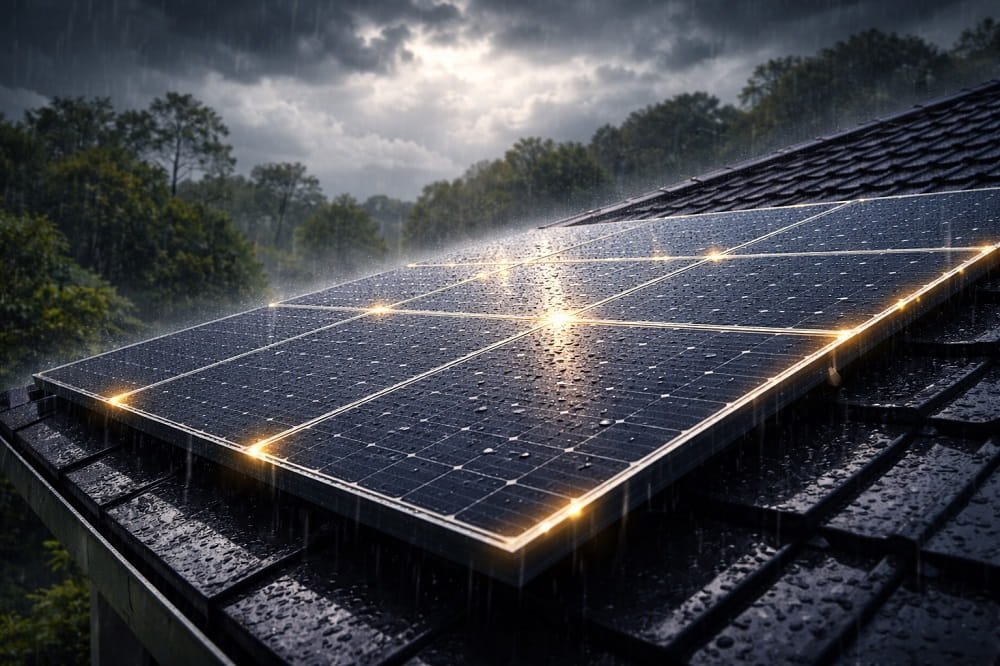
Monsoon performance is perhaps the most misunderstood aspect of solar energy adoption at home. The general assumption that people make regarding solar energy under monsoon season is technically incorrect.
Solar generation is based on irradiance, not visible sun. You will get some on the surface of the module even with heavy cloud cover. Solar generation does not disappear, it decreases.
To understand how rooftop solar panels for home perform during monsoon season, one should evaluate them based on irradiance level, temperature behavior, design, and annual modeling; none of these should be based on perception.
Irradiance During Cloud Cover: What Actually Happens
Standard Test Conditions (STC) rate solar modules at 1000 W/m² irradiance and 25°C cell temperature. Monsoon irradiance typically ranges between:
- 150–300 W/m² during heavy overcast
- 300–600 W/m² during broken cloud cover
- 600+ W/m² during post-rain bright intervals
At 300 W/m², a module rated at 550 W under STC will theoretically produce around 30% of rated output, adjusted for temperature and system losses.
Output reduction is proportional to irradiance. The photovoltaic effect continues as long as light photons strike the semiconductor surface.
Clouds scatter radiation. They do not eliminate it.
Diffuse Radiation Contribution
Under monsoon conditions, direct beam radiation decreases significantly. Diffuse radiation increases.
Modern mono PERC modules and half-cut cell configurations perform efficiently under diffuse light because:
- Lower internal resistance improves low-irradiance response
- Multi-busbar architecture reduces recombination losses
- Anti-reflective coatings enhance photon capture
Diffuse-heavy conditions can still deliver 20–60% of system capacity depending on cloud density and duration.
Performance is variable. It is not zero.
Temperature Behavior During Monsoon
Module efficiency is temperature-dependent. The temperature coefficient of most crystalline silicon modules ranges from -0.34% to -0.40% per °C above 25°C.
During peak summer:
- Module surface temperatures can exceed 60–70°C
- Efficiency drops significantly
During monsoon:
- Ambient temperatures reduce
- Cloud cover limits heat buildup
- Rain cools module surfaces
Lower operating temperatures partially offset reduced irradiance.
In many cases, energy yield per unit irradiance improves during cooler monsoon days compared to extreme summer heat.
Soiling Losses and Natural Cleaning
Pre-monsoon dust accumulation in Indian cities can cause 5–15% output loss. Rainfall reduces surface dust significantly.
Post-rain performance often improves temporarily due to:
- Reduced surface soiling
- Enhanced light transmission
- Lower cell temperature
Sustained heavy rainfall with continuous cloud cover reduces output. Intermittent rain combined with cloud breaks stabilizes generation.
Rain is operationally neutral or beneficial for module health when installation quality is correct.
Inverter Performance in Low Irradiance
Inverters require minimum DC input voltage to begin conversion. During very low irradiance:
- String voltage may approach startup threshold
- MPPT tracking adjusts to fluctuating light conditions
High-quality inverters maintain better MPPT efficiency under dynamic irradiance. Poorly specified inverters show higher conversion losses during monsoon variability.
System performance during cloudy days is heavily influenced by inverter selection and DC string design.
This is a system engineering issue, not a weather issue.
Seasonal Energy Yield Modeling
Monsoon reduces daily generation. Annual yield remains within predictable tolerance.
Typical generation pattern in Indian conditions:
- March–May: Peak output
- June–September: 25–50% seasonal reduction
- October–February: Stable moderate generation
Annual performance ratio remains within expected design range when systems are sized based on yearly load, not peak month output.
Professional system design calculates:
- Annual irradiation data
- Module degradation rates
- System losses (temperature, wiring, inverter, soiling)
- Net metering impact
This modeling prevents seasonal shock.
Companies experienced in residential deployment, such as Infrax Renewable, incorporate long-term irradiance datasets before capacity recommendation. Monsoon reduction is already accounted for in projected ROI.
Grid-Tied Compensation
Grid-connected rooftop solar panels for home are designed around annual energy balance.
High-production months export surplus units.
Monsoon months import deficit units.
Net metering neutralizes seasonal imbalance.
Without grid interconnection, cloudy-day performance feels inadequate.
With grid integration, annual savings remain stable.
The system must be evaluated across 365 days — not a single rainy week.
Impact of Continuous Heavy Rainfall
Extended low-irradiance periods (3–5 consecutive heavily overcast days) result in sustained reduced generation.
However:
- Household daytime base loads are often lower during monsoon
- Cooling demand reduces
- Seasonal load shift partially offsets generation drop
Energy consumption patterns also change with weather.
This dynamic balance is rarely discussed but materially relevant.
Structural and Electrical Integrity During Monsoon
Performance stability depends on installation quality:
- Proper module tilt (typically 10–25° depending on region) prevents water stagnation
- IP-rated junction boxes prevent moisture ingress
- MC4 connectors must be correctly crimped and sealed
- Earthing systems must comply with safety norms
Electrical faults during monsoon are almost always installation failures — not panel limitations.
High-wind conditions during storms also test mounting integrity. Structural engineering must account for wind load as per regional codes.
Weather resilience is a design responsibility.
Cloud Edge Effect
Under certain conditions, when sunlight passes around thick cloud edges, irradiance briefly exceeds standard levels due to light concentration.
This phenomenon can produce short spikes above rated capacity.
While temporary, it demonstrates that cloud dynamics are complex — not purely suppressive.
Realistic Output Expectation
For practical understanding:
- A 5 kW residential system may generate 20–28 units/day in peak summer
- During heavy monsoon overcast, output may drop to 5–10 units/day
- During intermittent cloud conditions, generation may range 10–18 units/day
Annual generation remains within projected band if properly engineered.
Performance must be assessed in kilowatt-hours over time — not visually judged by sky conditions.
Long-Term Reliability Perspective
Solar modules are tested under:
- Damp heat conditions
- Thermal cycling
- Humidity freeze testing
- Mechanical load testing
Monsoon conditions fall well within certified operating limits.
Performance degradation over 25 years is primarily driven by material aging — not seasonal cloud cover.
Clouds influence short-term yield.
They do not influence system lifespan.
What Homeowners Must Audit Before the First Monsoon Hits
Most performance complaints during rainy season are not about weather. They are about preparation failure.
Before monsoon begins, every homeowner using rooftop solar panels for home should verify five operational checkpoints. These directly influence cloudy-day stability, safety, and yield retention.
This is not marketing advice. It is operational discipline.
- Drainage Path Verification
Standing water around mounting bases accelerates corrosion. Roof slope and water exit paths must remain clear. Blocked drains create structural stress over time.
- DC Cable Elevation
Cables should never rest directly on the roof surface. Water contact increases insulation stress and mechanical wear.
- Earthing Resistance Check
Moist soil reduces earthing resistance, which is good — but only if the system grounding was installed correctly. Annual resistance testing is non-negotiable.
- SPD (Surge Protection Device) Health
Lightning density increases during monsoon. SPD indicators must be inspected. A failed SPD silently removes your first protection layer.
- Inverter Error Log Review
Cloud fluctuation causes voltage swings. Reviewing inverter logs helps identify early MPPT instability or string mismatch before it becomes performance loss.
Ignoring these points results in blaming clouds for technical negligence.
Monsoon preparedness checklist for rooftop solar panels for home:
| Inspection Area | What to Check | Why It Matters During Monsoon | Recommended Action |
| Module Surface | Cracks, delamination, frame gaps | Water ingress risk | Visual inspection every 3 months |
| Mounting Structure | Bolt torque, rust spots | Wind load stability | Torque recheck before peak monsoon |
| DC Wiring | UV cracks, loose connectors | Moisture-induced faults | Replace damaged insulation immediately |
| Earthing System | Resistance value (<5 ohms preferred) | Lightning & surge protection | Test annually |
| Inverter Ventilation | Blocked airflow, moisture | Overheating during humid days | Clean and ensure dry mounting location |
These checks require minimal cost compared to system downtime.
Clouds reduce output.
Poor preparation destroys reliability.
Well-installed rooftop solar panels for home are weather-ready. Poorly maintained systems are not.
Conclusion
Monsoon reduces irradiance. Reduced irradiance reduces output. The relationship is linear and predictable.
Solar modules continue operating under diffuse light. Cooler temperatures partially offset losses. Grid integration stabilizes annual energy balance.
Well-designed rooftop solar panels for home are engineered for seasonal variability from the beginning.
Clouds change intensity. They do not switch off photovoltaic physics.

