
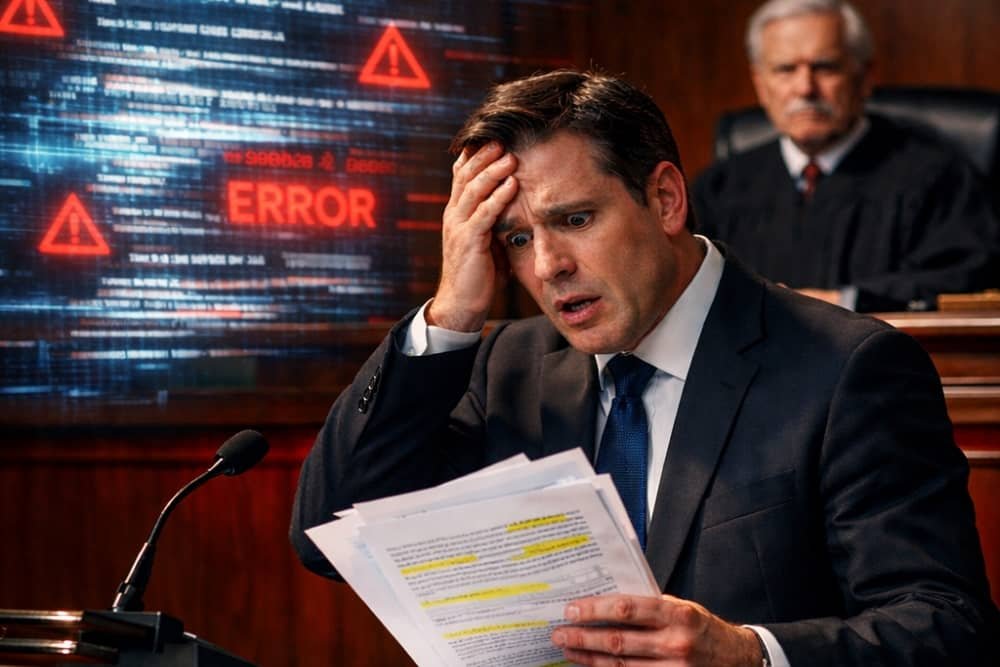
Picture this: You are a federal judge reviewing a legal brief. The arguments seem solid, the case citations look professional, and the legal analysis appears thoroughly researched. You start checking the citations. The first case does not exist. Neither does the second. Or the third. In fact, 12 of the 19 cases cited are completely fabricated – made up by artificial intelligence and submitted to your court as if they were real.
This is not a dystopian future scenario. This is happening right now, in courtrooms across America, every single day.
The Crisis in Numbers
712 documented cases of AI-hallucinated content in legal decisions worldwide (90% in 2025 alone)
2-6 new cases per day as of December 2025, up from 2 per week in early 2025
Sanctions ranging from $2,000 to $31,000+ in single cases
Career-ending suspensions, disqualifications, and state bar referrals becoming routine
What Are AI Hallucinations?
AI hallucinations occur when large language models like ChatGPT, Claude, Google Gemini, or Microsoft Copilot generate information that is completely fabricated but presented with absolute confidence. These are not simple errors or typos – they are plausible-sounding fiction dressed up as fact.
Here is the technical reality: ChatGPT and similar tools are NOT search engines. They do not access legal databases like Westlaw or LexisNexis. They do not retrieve actual documents. Instead, they predict the next most likely word based on patterns learned from training data.
When you ask ChatGPT for case law about airline liability, it does not search for real cases. It generates text that LOOKS LIKE a case citation based on what legal citations typically look like. The result? A completely fake case that passes visual inspection.
The Alarming Hallucination Rates
Research reveals shocking frequency:
– 17-33% hallucination rate for leading legal AI research tools in Stanford studies
– Consumer AI platforms fare even worse
– No AI platform is immune – errors from ChatGPT, Google Bard, Microsoft Copilot, Perplexity, and Claude have appeared in court filings
The Case That Started It All: Mata v. Avianca (2023)
Steven Schwartz, a New York attorney with over 30 years of experience, used ChatGPT to research a personal injury case against Avianca Airlines. The AI generated six completely fabricated cases with convincing names: Varghese v. China Southern Airlines, Shaboon v. Egyptair, Martinez v. Delta Airlines, and three others, complete with fake quotes, internal citations, and judicial reasoning Judge Castel later described as gibberish.
When Avianca lawyers could not locate the cases, Schwartz did something unthinkable: he asked ChatGPT if the cases were real. The AI doubled down, insisting the cases existed and could be found on Westlaw and LexisNexis.
Schwartz believed the AI. He submitted an affidavit containing these fake cases. Even after Judge Castel issued orders questioning their existence, Schwartz continued to defend them.
The Consequences
– $5,000 fine split between Schwartz, co-counsel, and their firm
– Public humiliation: Required to send letters to the client and to each judge falsely named as authoring the fake opinions
– Professional reputation destroyed: The case made international headlines
– Case dismissed: The client lost their legitimate injury claim
Morgan & Morgan: When America Largest PI Firm Falls (2025)
Even Morgan & Morgan, a 900+ attorney powerhouse, fell victim. A lawyer used the firm own in-house AI platform to locate case requirements for motions. The AI generated perfect-looking citations that did not exist. Three attorneys signed the filings. None verified the cases.
To their credit, Morgan & Morgan immediately withdrew the motions, were honest about AI use, paid opposing counsel fees, and implemented new firm-wide policies. The court still found a Rule 11 violation.
Critical Lesson: If a 900-lawyer firm with dedicated IT resources and an enterprise AI platform can fall victim, solo practitioners using free ChatGPT are playing Russian roulette.
The $31,000 Bombshell: Sanctions Skyrocket
Judge Michael Wilner discovered fabricated legal citations in a supplemental brief. His response? $31,000 in sanctions against two law firms – the largest AI hallucination fine on record at the time.
Why the massive fine? Lower fines were not deterring the behavior. Legal experts predict it may take ruinous fines to get lawyers to truly pay attention.
Why Smart Lawyers Keep Making Dumb Mistakes
Fundamental Misunderstanding of How AI Works
The single biggest problem? Lawyers think ChatGPT is a search engine. Schwartz testified he believed it was a super search engine. This misunderstanding is catastrophic.
Blind Trust in Technology
Lawyers have spent decades trusting Westlaw and LexisNexis. When they encounter AI tools with professional interfaces and confident outputs, they transfer that trust inappropriately.
Time Pressure and Economic Incentives
AI promises speed. Legal research that once took hours can now take minutes. For solo practitioners, every hour counts. For BigLaw associates, partners demand fast turnarounds. The temptation to skip verification is overwhelming when deadlines loom.
The False Reassurance When You Ask AI “Are You Sure?”
Perhaps most insidious: when lawyers ask AI to verify its own hallucinations, the AI doubles down. AI does not have epistemic uncertainty. It does not KNOW when it is lying because it does not KNOW anything. It just generates the next most statistically probable tokens.
The True Cost: Beyond Fines and Sanctions
Career and Reputation Destruction
Steven Schwartz practiced law for over 30 years. His name is now synonymous with AI legal failures. Google his name, and the first 10 pages are about the Avianca case. His professional legacy has been obliterated by a single mistake.
Client Harm: When Legitimate Cases Die
Roberto Mata had a potentially legitimate personal injury claim. His lawyers AI failures got the case dismissed. Mata lost his day in court because his attorneys trusted ChatGPT.
Judicial System Burden
Courts already facing massive backlogs and understaffing now must verify every citation, research sanctions law for AI hallucinations, hold show-cause hearings, and draft sanction orders. Time taken from actual justice.
The Survival Guide: How to Protect Yourself
Rule #1: Understand What AI Actually Is
CRITICAL: AI is not a search engine. It is not a legal database. It is a text prediction machine. Think of AI as a sharp but green first-year associate who sounds incredibly confident even when completely wrong, will make up citations rather than admit not knowing, and cannot be trusted without verification.
Rule #2: Verify Every Single Citation – NO EXCEPTIONS
- Pull up the actual case on Westlaw, LexisNexis, or Bloomberg Law
- Read the relevant portions yourself
- Check that quotes are accurate and in proper context
- Confirm the case has not been overruled
- Verify jurisdiction matches your case
If you cannot find a case AI cited, STOP. Do not file it. Do not ask AI to verify – it will lie. Do actual legal research.
Rule #3: Choose Your AI Tools Wisely
Legal-Specific Platforms (Safer): Harvey AI, CoCounsel, Westlaw Precision, LexisNexis+ – Actually connected to legal databases, designed for legal work, still require verification
Consumer Platforms (Extremely Risky): Free ChatGPT, Google Gemini, Claude, Perplexity – No legal database access, high hallucination rates, may use inputs for training
Rule #4: Create Firm Policies NOW
Implement approved tools list, mandatory verification procedures, required disclosure to supervising attorneys, confidentiality protocols, training requirements, and incident reporting procedures.
Rule #5: Be Transparent About AI Use
Disclose to clients when AI assists representation, check local rules (some courts require AI disclosure), when questioned be immediately honest, and document your verification process.
The Bottom Line
712 documented cases of AI hallucinations. Hundreds more undoubtedly went undetected. Millions of dollars in sanctions. Careers destroyed. Clients denied justice. Courts overwhelmed. Public trust eroding.
The technology is not the villain. ChatGPT does not file briefs. Claude does not sign pleadings. Lawyers do.
Every sanctioned attorney made a choice – to trust without verifying, to prioritize speed over accuracy, to delegate professional judgment to an algorithm.
Which lawyer will you be?
The lawyers who thrive will leverage AI strengths while maintaining professional judgment, ethical obligations, and verification discipline.
The lawyers who fail will believe the hype, trust the outputs, skip verification, and pray they do not get caught. They will join the 712 documented cases. They will pay the fines, suffer the suspensions, write the letters of apology.
Share this article with every lawyer you know. It might save their career.

