
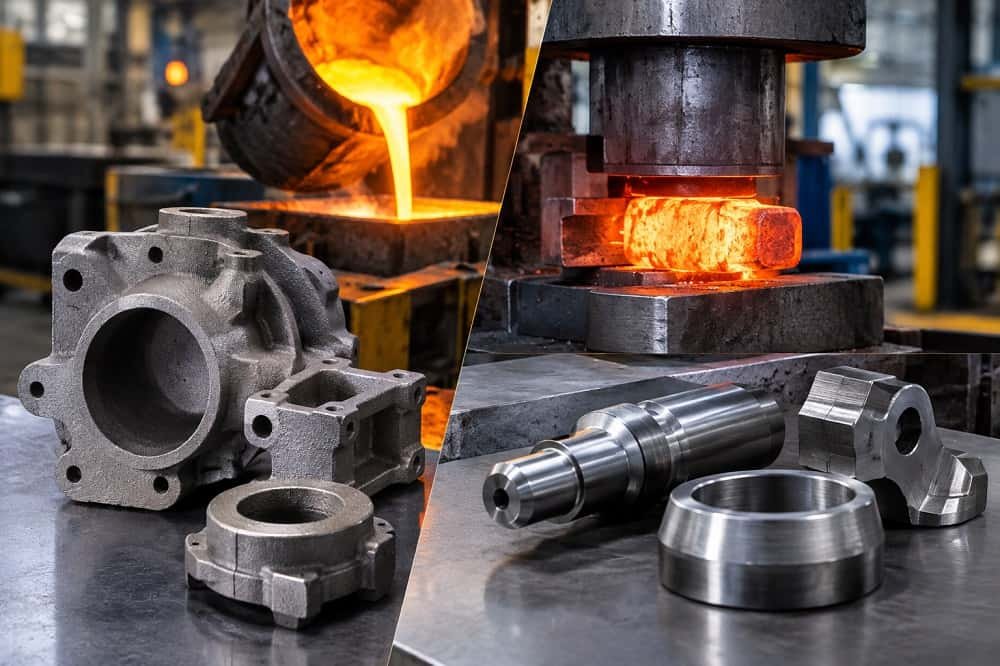
Components made from tool steel find use in a variety of applications where strength, hardness, wear resistance, and dimensional stability are vital. Dies, moulds, cutting tools, punches, wear plates, and other tooling elements often undergo extreme forces and temperatures. As a result, the choice of manufacturing method for such elements directly impacts the performance, reliability, and cost.
Processes such as tool steel castings, forging, and other methods can yield high-quality components. They differ significantly in terms of the ways of shaping the metal, as well as internal structure and mechanical properties.
Tool Steel: Casting Vs Forging Overview
Casting process involves heating steel to the melting point, followed by pouring the metal into a mould. After solidification, the metal is retrieved from the mould, then subjected to various operations, such as heat treatment, machining, grinding, or other finishing activities.
The advantage of tool steel castings lies in its ability to produce near-net parts with high complexity. Deep cavities, narrow extensions, and other intricate details are often replicated directly from the mould. However, the solidification process requires experience and precision since improper feeding may result in porosity, shrinkage, segregation, and other detrimental metallurgical phenomena detrimental to the end product.
Forging is a deformation process, which involves heating steel billets or ingots, then applying compressive forces to obtain the desired shape and size. Various types of forging equipment can be used depending on the forging group, material, and production volume.
Unlike tool steel castings, forging does not require a mould. Instead, mechanical energy is applied to deform the metal. Forging affects the metal in a way that it promotes directional metallurgical changes making the metal denser, stronger, and more resistant to shock loads. This is particularly advantageous for drop forging, stamping, or heavy stampings.
On the downside, forging is not always compatible with the most complex geometrical configurations. In addition, depending on the forging group, additional machining may be required.
Comparing The Strength and Internal Structure
As mentioned earlier, internal structure and mechanical properties of cast and forged steel are different. As a metal is heated up to the melting point, its crystalline structure changes. The formation of new crystals during solidification is a relatively slow process, and the size and shape of the crystals depend on the cooling rate.
Therefore, it is necessary to apply proper heat treatment to cast steel in order to obtain the necessary structure and properties.
On the other hand, the forging process does not allow the formation of intermetallic compounds. The crystals are refined and their orientation is aligned in the direction of metal flow and forging pressure. Such metal displays higher strength and impact resistance than cast steel. The choice of the method, in this case, is based on the need to increase the toughness of the workpiece or its complex geometry.
Tool Steel Castings VS Forging: Which Process Provides Higher Wear Resistance?
The wear resistance of tool steels depends on several factors, including the type of steel, its chemical composition, degree of heat treatment, and surface state. In principle, the same applies to both cast and forged components. However, the manufacturing process indirectly affects the formation of the surface layer of the metal.
As a rule, castings do not require extensive machining to achieve the necessary dimensional accuracy and surface quality. At the same time, the mechanical properties of cast tool steels may be inferior to those of forged ones. Using an appropriate forging mode, it is possible to obtain a forged steel with a uniform structure with high impact strength and hardness. Thus, depending on the application, cast and forged steels can have comparable or different levels of wear resistance.
Tool Steel Casting VS Forging: Evaluating Costs
Cost is one of the decisive factors in choosing a particular manufacturing process. Both processes have advantages and disadvantages in this regard. It is also worth considering that the two processes are often competitive for the production of certain types of parts.
The cost of casting can be significantly lower compared to other processes, especially when the geometry of the casting is complex and requires extensive machining. The casting process allows one to obtain a part with a complex spatial configuration as the metal is in a liquid state and flows into all details of the mould. In addition, casting is a relatively simple process that does not require high pressure. Thus, for the production of geometrically complex parts in quantities, the casting process has significant advantages over forging.
In the case of forging, the cost mainly depends on the type of dies used and the forging equipment, as well as the complexity of the part being forged. The higher the complexity of the part, the more expensive the forging tools are. The cost of forging becomes comparable to casting when the forgings are produced in large quantities.
However, when choosing a particular type of manufacturing process, it is necessary to take into account not only the costs of the processes themselves but also the costs of subsequent operations. These include heat treatment, machining, and other works related to finishing the part. The width of the strip, the quantity of materials, allowances, and tolerances, as well as the likelihood of rejects, should also be considered. Another essential component in forming the cost is the requirements and specifications of the final application, including the required strength and operating conditions.
Tool Steel Castings VS Forging: Analyzing the Complexity of Geometries
Tool steel casting process allows obtaining parts with a high degree of geometrical complexity and asymmetry. It is possible to produce parts with thin walls and wide surfaces, deep cavity holes, and large protrusions. Compared to standard processes, such details do not require subsequent machining. Thus, this method is ideal for tooling and other applications that require non-standard shapes and sizes.
A forging process is more suitable for producing parts with a simpler shape. Although modern forging equipment and techniques allow obtaining relatively high dimensional accuracy, subsequent machining may be required for complex details. It should also be noted that for tool steel components, the machining process is relatively more resource-intensive due to the higher alloy content and overall hardness of the metal.
For highly precise components, the choice of either of the two manufacturing processes is not final but rather a step in the production of the tooling component. In order to achieve the necessary tolerances and surface roughness, it may be necessary to perform several operations, including milling, grinding, and electro-erosion.
Role of Heat Treatment
Heat treatment of steel is a process of thermal and mechanical treatment aimed at improving specific structural and performance features of the metal to ensure its reliable operation in specified environments.
A variety of heat treatments are used for both cast and forged steels, including normalization, tempering, quenching, and others. The selected method depends on the type of steel and the required operating properties of the component.
In the context of casting, the heat treatment process plays a special role. The structure of the metal obtained by casting differs in that it is more brittle and less strong. Therefore, it is necessary to apply the most optimal methods of heat treatment.
In the process of forging, the metal is heated to a temperature close to the melting point, so that subsequent heat treatment is not a mandatory process. While forging cannot replace heat treatment, the two processes complement each other, and their combined use allows one to obtain high-strength steel components.
Tool Steel Casting VS Forging: Partner Selection Considerations
It is challenging to estimate the final quality of the component produced using either of the two processes. The choice of the process is only a minor detail in the overall manufacturing process. The proper selection of the material and the development of the technologies for its processing are of particular importance. The experience of the manufacturer in the field of precision casting, forging, and machining of tool steel components is of particular importance.
Thus, in order to obtain a reliable component with the required performance characteristics, it is necessary to work with a professional partner who has high competences in the technologies of metal processing.
Siddhalaxmi provides solutions for a wide range of industrial needs in which the requirement for high-quality metal components is critical. By considering the capabilities of manufacturers, it is possible to select the most cost-effective process for producing a tooling component.
Casting or Forging: Which Is Better?
There is no right answer as to which process is better. It’s all about the component and what it needs to do.
Casting could be the right process if:
- The geometry of the part is very complex or intricate
- You want to avoid extensive machining
- You need large or unique looking parts
- Economics dictate a moulding process
Forging could be the right process if:
- The part needs to be tough and impact resistant
- The part will see heavy service
- The component requires an intricate yet dense grain structure
- The geometry of the part can be manipulated to fit inside dies
In some cases, it may even be a combination of the two! A casting can be machined and heat treated to meet the specifications of a certain application, or a forging can be machined to a precise dimension for a tooling application. The process is about meeting requirements, not about which is better.
Conclusion
The choice between tool steel castings and forging should be made based on the specific performance needs rather than any assumptions about which process is inherently better. Casting can offer significant design flexibility for components and can be extremely useful for complicated configurations, whereas forging can enable greater grain refinement and improved resistance to forces.
Careful analysis of the material grade, component geometry, production volume, heat treatment, dimensional accuracy, and service conditions should be made to determine the most appropriate process. By considering all of the above it will be possible to select the method most suited to the particular application, providing the required level of reliability, cost control, and performance for the component in service.

