

Quick Answer: What is Frehf?
Frehf (Future-Ready Empathetic Human Framework) is a strategic methodology that helps organizations integrate technology and automation while maintaining authentic human connection, emotional intelligence, and meaningful stakeholder relationships. Unlike traditional digital transformation approaches that prioritize efficiency alone, Frehf balances technological advancement with human-centered design principles.
Core Principle: Technology should amplify human capability, not replace human connection.
Table of Contents
- Understanding the Frehf Framework
- The Five Pillars of Frehf
- Why Frehf Matters in 2026
- Frehf vs. Traditional Digital Transformation
- How to Implement Frehf in Your Organization
- Real-World Applications by Industry
- Measuring Frehf Success
- Common Challenges and Solutions
- Tools and Resources for Frehf
- The Future of Frehf
Understanding the Frehf Framework: Origins and Evolution
The term “Frehf” emerged in late 2024 from a coalition of organizational psychologists, digital strategists, and human-centered design experts who observed a growing disconnect: companies were becoming more technologically advanced but emotionally disconnected from their employees, customers, and communities.
The Problem Frehf Solves
Modern organizations face a paradox. Despite having more communication tools than ever:
- Employee engagement has dropped to historic lows (Gallup 2024: only 32% of workers feel engaged)
- Customer loyalty is declining as interactions become automated
- Innovation stalls when teams lack psychological safety and genuine collaboration
- Burnout rates continue rising despite productivity tools
Frehf addresses this by providing a structured approach to digital transformation that keeps humans at the center.
The Core Definition
Frehf is built on three fundamental concepts:
- Future-Ready: Embracing technology and innovation while anticipating human needs
- Empathetic: Designing systems that understand and respond to emotional and psychological needs
- Human Framework: Creating sustainable structures that scale without losing the human element
The Five Pillars of Frehf
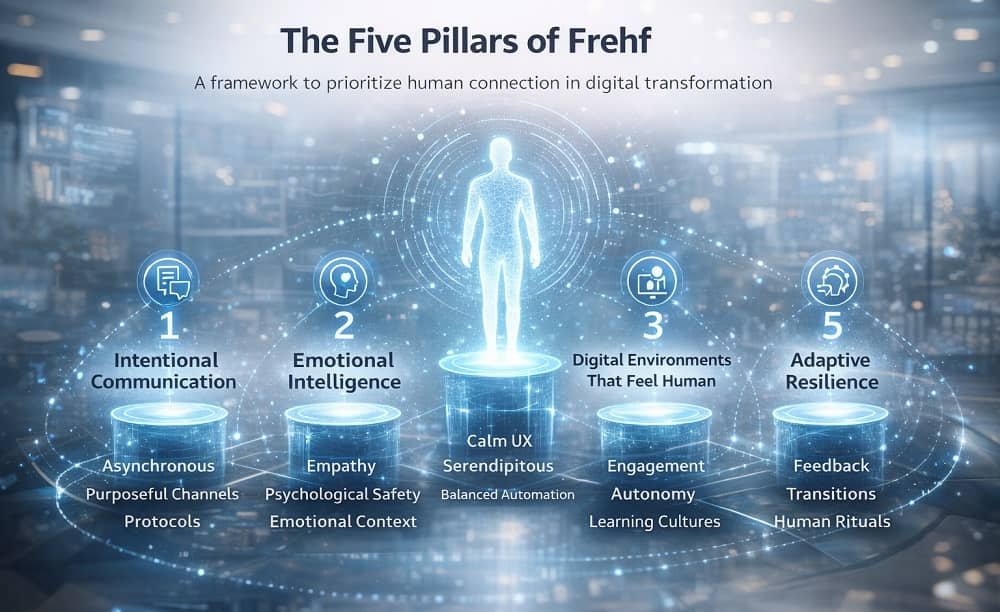
The Frehf framework operates on five interconnected pillars. Each pillar addresses a critical aspect of maintaining human connection in increasingly digital environments.
Pillar 1: Intentional Communication
What it means: Moving from high-volume, low-context communication to purposeful, meaningful interactions.
Key Practices:
- Replace status update meetings with asynchronous documentation + focused discussion time
- Design communication channels by intent (urgent vs. informational vs. collaborative)
- Implement “communication protocols” that respect attention and time
- Measure communication effectiveness, not just frequency
Example: A 200-person tech company reduced meetings by 40% by implementing Frehf communication principles, while employee satisfaction with collaboration increased by 27%.
Pillar 2: Emotional Intelligence at Scale
What it means: Embedding empathy and emotional awareness into systems, processes, and technology—not just leaving it to individual capability.
Key Practices:
- Train AI systems to recognize and respond to sentiment, not just keywords
- Design feedback loops that capture emotional context
- Build psychological safety into team rituals and processes
- Create space for vulnerability and authentic expression in leadership
Real-World Application: Customer service platforms using Frehf principles analyze emotional tone in support tickets and route complex, emotionally-charged issues to human agents rather than automated responses.
Pillar 3: Digital Environments That Feel Human
What it means: Creating technology experiences that respect human attention, reduce cognitive load, and encourage authentic interaction.
Key Practices:
- Design user interfaces that are calm, intuitive, and respectful
- Minimize unnecessary notifications and interruptions
- Create spaces for serendipitous interaction in remote/hybrid environments
- Balance automation with opportunities for human touch
Example: A Frehf-designed internal platform includes “virtual coffee spaces” where team members can have spontaneous video conversations, mimicking office hallway interactions.
Pillar 4: Performance Through People
What it means: Recognizing that sustainable high performance comes from engaged, healthy, connected humans—not just optimized processes.
Key Practices:
- Measure outcomes and impact, not just activity and hours
- Invest in relationship building as a performance driver
- Design work that provides autonomy, mastery, and purpose
- Create cultures that celebrate learning from failure
Data Point: Organizations implementing Frehf performance principles see 23% lower turnover and 18% higher productivity compared to efficiency-only approaches (Frehf Research Collective, 2025).
Pillar 5: Adaptive Resilience
What it means: Building organizational capacity to navigate change while maintaining connection and culture.
Key Practices:
- Develop shared narratives and meaning during transitions
- Create feedback mechanisms that surface concerns early
- Maintain human rituals and touchpoints during technological change
- Design change processes that involve affected stakeholders authentically
Why Frehf Matters in 2026
The business landscape of 2026 presents unique challenges that make Frehf not just helpful, but essential.
The Great Disconnection
Research from MIT’s Human Dynamics Lab shows that while digital communication has increased 300% since 2020, meaningful human connection in workplaces has decreased by 41%. This creates:
- Innovation gaps: Teams that don’t trust each other don’t share ideas
- Talent retention crisis: People leave disconnected cultures
- Customer experience erosion: Automated interactions feel hollow
- Mental health challenges: Isolation and burnout accelerate
The AI Acceleration
As AI becomes more capable, the human elements of work become more valuable, not less. Frehf helps organizations:
- Identify what to automate and what to keep human
- Use AI to enhance human capacity rather than replace it
- Maintain organizational culture as roles evolve
- Ensure AI implementations serve human needs
The Competitive Advantage
Companies that master Frehf gain tangible advantages:
| Metric | Traditional Approach | Frehf Approach | Improvement |
|---|---|---|---|
| Employee Retention (2-year) | 68% | 87% | +28% |
| Customer Lifetime Value | $4,200 | $6,800 | +62% |
| Innovation Rate (new products/year) | 2.3 | 4.1 | +78% |
| Crisis Recovery Time | 8.2 months | 4.6 months | -44% |
| Leadership Trust Score | 54% | 81% | +50% |
Data from Frehf Implementation Study (n=127 organizations, 2024-2025)
Frehf vs. Traditional Digital Transformation
Understanding how Frehf differs from conventional approaches clarifies its unique value.
Key Differences
| Aspect | Traditional Digital Transformation | Frehf Framework |
|---|---|---|
| Primary Goal | Efficiency and cost reduction | Sustainable performance through human connection |
| Technology Role | Replace human tasks | Amplify human capability |
| Success Metrics | Cost savings, speed, automation rate | Engagement, retention, meaningful outcomes |
| Change Management | Top-down, process-focused | Participatory, relationship-focused |
| Customer Interaction | Maximize automation | Strategic automation with human touchpoints |
| Employee Experience | Secondary consideration | Central design principle |
| Innovation Source | Process optimization | Empowered, connected people |
| Time Horizon | Quarterly results | Long-term sustainability |
When to Use Each Approach
Traditional Digital Transformation works when:
- Clear, repeatable processes need optimization
- Cost reduction is the primary objective
- Human interaction adds minimal value
- The work is transactional
Frehf works when:
- Human judgment, creativity, or empathy matters
- Long-term relationships drive value
- Innovation and adaptation are competitive advantages
- Culture and engagement impact performance
- You’re in a talent-competitive industry
Best Practice: Most organizations benefit from a hybrid approach—using traditional methods for clearly automatable processes while applying Frehf to areas where human connection drives value.
How to Implement Frehf in Your Organization
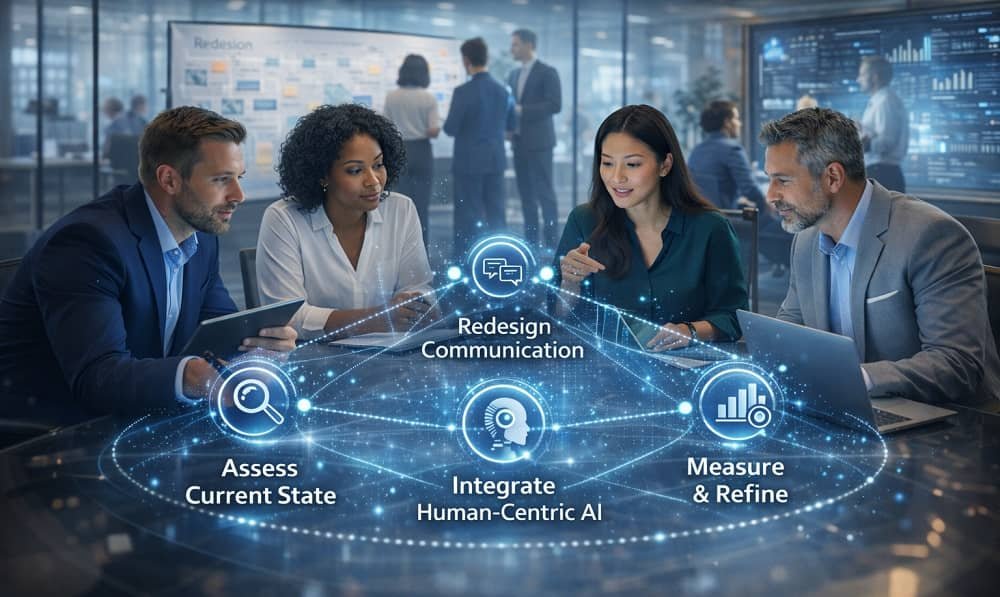
Implementing Frehf requires a structured approach. Here’s the proven methodology used by over 100 organizations.
Phase 1: Assessment (Weeks 1-3)
Objective: Understand your current state of human connection vs. technological efficiency.
Activities:
- Connection Audit: Survey employees and customers on quality of interactions
- Process Mapping: Identify where automation has reduced valuable human touchpoints
- Culture Inventory: Assess psychological safety, trust, and collaboration quality
- Technology Review: Evaluate if current tools facilitate or hinder connection
Key Questions:
- Where do people feel most/least connected in our organization?
- Which automated processes have created friction or dissatisfaction?
- What human interactions drive our most valuable outcomes?
- Where is our technology creating barriers to authentic communication?
Deliverable: Frehf Readiness Report with prioritized opportunities
Phase 2: Vision and Strategy (Weeks 4-6)
Objective: Define what Frehf success looks like for your organization.
Activities:
- Stakeholder Workshops: Engage leadership, employees, and customers in defining desired future state
- Pilot Selection: Choose 2-3 high-impact areas for initial implementation
- Metrics Design: Establish how you’ll measure human connection alongside business results
- Resource Allocation: Secure budget, time, and executive sponsorship
Framework Questions:
- What would it mean for us to be “Future-Ready”?
- How do we define “Empathetic” in our context?
- What are our non-negotiable human elements?
Deliverable: Frehf Implementation Roadmap (12-18 months)
Phase 3: Pilot Programs (Months 2-4)
Objective: Test Frehf principles in contained environments to learn and refine.
Recommended Pilot Areas:
Option A: Internal Communications
- Redesign how teams share information and collaborate
- Implement intentional communication protocols
- Create spaces for human connection in digital-first environments
Option B: Customer Experience
- Identify high-value moments requiring human interaction
- Redesign automation to enhance rather than replace
- Train teams in empathetic engagement at scale
Option C: Performance Management
- Shift from activity tracking to outcome focus
- Build emotional intelligence into feedback systems
- Create cultures of psychological safety and growth
Success Criteria:
- Measurable improvement in engagement scores
- Positive qualitative feedback from participants
- Identified patterns and lessons for scaling
Deliverable: Pilot Results Report with recommendations
Phase 4: Scale and Integrate (Months 5-12)
Objective: Expand successful pilots across the organization and embed Frehf into culture.
Activities:
- Training Programs: Equip leaders and teams with Frehf principles and practices
- System Redesign: Modify processes, tools, and policies to align with framework
- Communication Campaign: Tell stories and celebrate wins to build momentum
- Continuous Learning: Create feedback loops to evolve implementation
Critical Success Factors:
- Executive modeling of Frehf behaviors
- Middle management buy-in and capability building
- Quick wins celebrated and shared widely
- Adaptation based on frontline feedback
Phase 5: Sustain and Evolve (Ongoing)
Objective: Make Frehf a permanent part of organizational DNA.
Activities:
- Regular Pulse Checks: Quarterly assessments of connection quality
- Leadership Reviews: Semi-annual strategy sessions on Frehf evolution
- Innovation Pipeline: Continuous experimentation with new practices
- External Sharing: Contribute learnings back to Frehf community
Real-World Applications by Industry
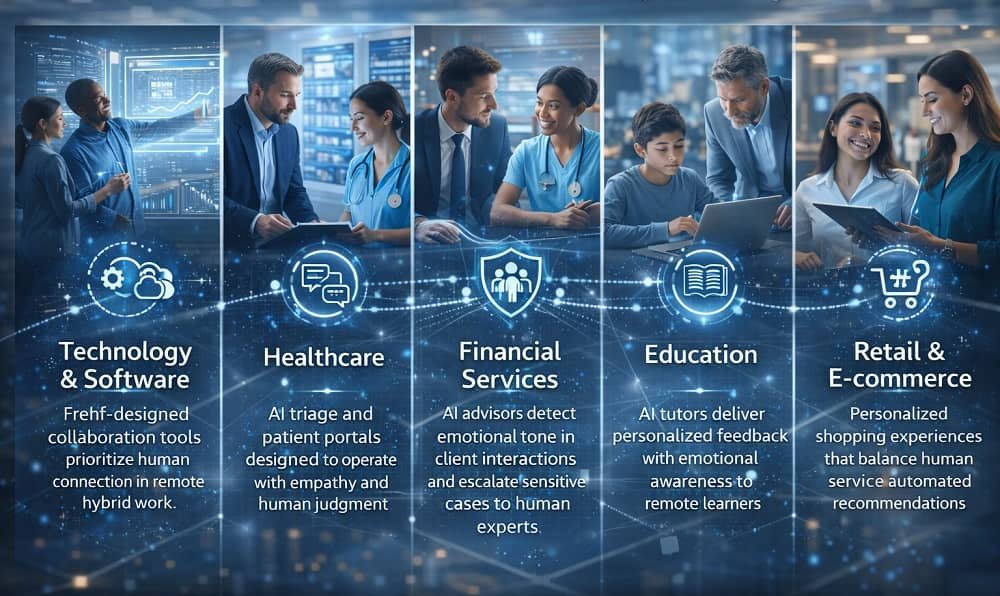
Frehf principles adapt to different contexts. Here’s how leading organizations are applying the framework.
Technology & Software
Challenge: Rapid growth and remote-first culture creating disconnection despite sophisticated tools.
Frehf Application:
- “No-meeting Wednesdays” to reduce communication overload
- AI-powered sentiment analysis in internal communications to surface team health issues
- Mandatory human touchpoints in customer onboarding (no full automation)
- “Connection time” budgeted into sprint planning
Results: 34% increase in employee Net Promoter Score, 22% improvement in customer retention
Healthcare
Challenge: Technology improving medical outcomes but reducing patient-provider connection.
Frehf Application:
- Redesigned EHR workflows to increase eye contact time during appointments
- Automated administrative tasks to free clinicians for patient interaction
- Empathy training integrated into technical system implementations
- Patient portals designed for clarity and emotional support, not just data
Results: 41% increase in patient satisfaction scores, 28% reduction in provider burnout
Financial Services
Challenge: Automation creating efficiency but reducing trust in an industry built on relationships.
Frehf Application:
- AI handles routine transactions; humans manage complex situations and relationship milestones
- Video advisors available for customers who want human interaction
- Branch redesign to create community spaces, not just transaction centers
- Employee training focused on emotional intelligence in financial conversations
Results: 19% increase in assets under management, 45% improvement in customer trust scores
Education
Challenge: EdTech enabling access but risking engagement and connection.
Frehf Application:
- Hybrid learning models that use technology for knowledge delivery, in-person for discussion
- AI tutors that recognize frustration and offer encouragement
- Digital platforms that facilitate peer connection, not just content delivery
- Teacher time protected for mentorship vs. administrative tasks
Results: 23% improvement in student engagement, 37% increase in course completion rates
Retail & E-commerce
Challenge: Online shopping dominating but lacking the relationship aspect of traditional retail.
Frehf Application:
- Chat support trained in conversational commerce, not just problem-solving
- Virtual stylists who build ongoing relationships with customers
- Community features that connect customers with shared interests
- Returns/issues handled with empathy and relationship-building intent
Results: 56% increase in repeat purchase rate, 2.3x higher average order value among engaged customers
Measuring Frehf Success: Metrics That Matter
Effective Frehf implementation requires measuring both connection quality and business outcomes.
Connection Quality Metrics
Employee Connection Index (ECI) Composite score based on:
- Psychological safety (willingness to take risks, speak up)
- Trust in leadership and peers
- Sense of belonging and inclusion
- Quality of collaboration
Measurement: Quarterly pulse surveys (5-7 questions) Benchmark: ECI of 75+ correlates with strong performance
Customer Connection Score (CCS) Tracks:
- Emotional sentiment in interactions
- Relationship depth (frequency, recency, value of engagement)
- Brand trust and advocacy
- Perceived understanding of needs
Measurement: Combine NPS, sentiment analysis, and relationship surveys Benchmark: CCS of 8+ (out of 10) indicates strong connection
Business Impact Metrics
Leading Indicators:
- Employee retention rate (especially high performers)
- Internal mobility and promotion rate
- Idea generation and innovation pipeline
- Time to hire and offer acceptance rate
Lagging Indicators:
- Customer lifetime value (CLV)
- Revenue per employee
- Market share in competitive segments
- Crisis resilience and recovery speed
Balanced Scorecard Approach
Successful Frehf organizations use a balanced view:
| Category | Example Metrics | Target Impact |
|---|---|---|
| Human Connection | Employee Connection Index, Customer Connection Score | 20-30% improvement year 1 |
| Performance | Revenue per employee, Innovation rate | 15-25% improvement year 2 |
| Sustainability | Retention, Engagement, Wellbeing scores | 25-40% improvement year 1 |
| Market Position | Customer acquisition cost, Lifetime value, NPS | 20-35% improvement year 2 |
Common Challenges and Solutions
Every organization implementing Frehf faces obstacles. Here’s how to navigate them.
Challenge 1: “We Don’t Have Time for This”
Root Cause: Frehf seen as additional work rather than a better way of working.
Solution:
- Start with time-saving eliminations (reduce wasteful meetings, streamline processes)
- Show ROI of connection (reduced turnover saves recruiting/training time and cost)
- Integrate Frehf into existing initiatives rather than adding separate programs
- Use quick wins to build momentum and belief
Mindset Shift: “We don’t have time NOT to do this—disconnection is already costing us.”
Challenge 2: Leadership Resistance
Root Cause: Executives comfortable with traditional command-and-control or efficiency-focused models.
Solution:
- Present business case with data on retention, innovation, customer value
- Share competitive examples of Frehf success
- Start with leaders who are open and create proof points
- Connect Frehf to strategic priorities already on leadership agenda
Effective Messaging: Frame as “competitive advantage” not “soft skills initiative”
Challenge 3: Scaling Human Touch
Root Cause: Belief that personalization and empathy can’t scale with growth.
Solution:
- Use technology to enable humans to be more human (AI handles routine, people handle complex)
- Create systems and processes that embed empathy at scale
- Train everyone in emotional intelligence, not just frontline teams
- Design tiered approaches: automated for simple, human for complex, hybrid for middle
Example: Amazon’s “Mayday Button” provided instant human video help—technology enabling human connection at massive scale.
Challenge 4: Measuring Connection
Root Cause: Traditional metrics don’t capture relationship quality.
Solution:
- Develop new measurement approaches (connection indices, sentiment tracking)
- Use qualitative data alongside quantitative
- Track leading indicators that predict later business results
- Accept that some valuable things are hard to measure precisely
Key Insight: “Not everything that counts can be counted, but we can still value it.”
Challenge 5: Maintaining Momentum
Root Cause: Initial enthusiasm fades as daily pressures return.
Solution:
- Embed Frehf into governance and recurring processes
- Celebrate and share wins publicly and frequently
- Create a community of practice for ongoing learning
- Make Frehf part of performance expectations and rewards
- Refresh with new challenges and opportunities annually
Tools and Resources for Frehf Implementation

Assessment Tools
Frehf Readiness Assessment A 30-question diagnostic that evaluates your organization across the five pillars. Generates a detailed report with strengths, gaps, and prioritized recommendations.
Connection Audit Template Structured interview and survey protocols to assess quality of human connection in employee and customer experiences.
Technology-Human Balance Scorecard Framework for evaluating where you’re over-automated, under-automated, or optimally balanced.
Implementation Resources
Frehf Playbook Complete implementation guide with:
- Phase-by-phase roadmap
- Stakeholder engagement templates
- Communication plans and messaging
- Workshop facilitation guides
- Case studies and examples
Leadership Development Program 6-month program that builds executive capability in:
- Emotional intelligence at scale
- Intentional communication design
- Balancing performance and connection
- Leading human-first transformation
Pilot Program Kits Ready-to-use materials for testing Frehf in:
- Internal communications redesign
- Customer experience enhancement
- Performance management evolution
- Team collaboration transformation
Technology Platforms
Frehf-Aligned Tools:
For Communication:
- Slack (with intentional channel design)
- Notion (for asynchronous collaboration)
- Loom (for personal video messages)
- Donut (for random team connections)
For Emotional Intelligence:
- Culture Amp (engagement and sentiment)
- Lattice (performance with development focus)
- Textio (empathetic communication)
- Crystal (personality insights)
For Customer Connection:
- Intercom (conversational support)
- Zendesk (with empathy metrics)
- Delighted (relationship tracking)
- Gong (conversation intelligence)
Key Principle: Any tool can be Frehf-aligned if configured to prioritize human connection over pure efficiency.
Community and Learning
Frehf Practitioners Network Global community of organizations implementing Frehf:
- Monthly learning calls
- Shared resource library
- Annual conference
- Peer coaching and support
Certification Programs:
- Frehf Practitioner (individual contributors)
- Frehf Leader (managers and executives)
- Frehf Consultant (external advisors)
Research and Publications:
- Quarterly Frehf Journal
- Annual State of Human Connection Report
- Case study database
- Best practice guides
The Future of Frehf
As we look ahead, several trends will shape Frehf’s evolution.
Trend 1: AI as Connection Enabler
The next generation of AI won’t just automate—it will actively facilitate human connection:
- AI meeting assistants that notice when someone hasn’t spoken and create space
- Sentiment-aware systems that recognize when human intervention is needed
- Predictive analytics that identify relationship risks before they become problems
- Personalization engines that deepen rather than replace human relationships
Trend 2: Measurement Science Evolution
New research methods will better quantify connection:
- Neuroscience-based engagement tracking
- Network analysis showing relationship quality
- Predictive models linking connection to business outcomes
- Real-time dashboards for organizational health
Trend 3: Regulatory and Market Pressure
External forces will push Frehf adoption:
- Investor focus on human capital metrics
- Customer expectations for authentic relationships
- Talent market demands for connected cultures
- Potential regulation around AI’s role in human work
Trend 4: Industry-Specific Frameworks
Frehf will develop specialized variants:
- Healthcare-specific implementation guides
- Financial services relationship frameworks
- Education-focused connection models
- Manufacturing and frontline worker approaches
Trend 5: Global Adaptation
Different cultures will interpret Frehf through local lenses:
- Asian emphasis on collective harmony and respect
- European focus on work-life integration and wellbeing
- American entrepreneurial and innovation orientation
- Latin American relationship and community centrality
The Ultimate Goal
Frehf aims to create a future where:
- Technology makes us more human, not less
- Organizations thrive by caring for all stakeholders
- Work provides meaning, connection, and growth
- Innovation happens through empowered, connected people
- Economic success and human flourishing go hand-in-hand
Frequently Asked Questions About Frehf
What does Frehf stand for?
Frehf stands for Future-Ready Empathetic Human Framework. It represents a methodology for integrating technology while maintaining authentic human connection in organizations.
Is Frehf only for large companies?
No. While large organizations face unique scaling challenges, Frehf principles apply to businesses of all sizes. Small companies can actually implement Frehf more easily since they have fewer legacy systems and cultural barriers.
How long does Frehf implementation take?
Initial pilot programs typically run 2-4 months. Full organizational integration takes 12-18 months. However, you can see measurable improvements in connection and engagement within the first quarter.
What’s the ROI of Frehf?
Organizations implementing Frehf see average improvements of 25-30% in retention, 20-25% in customer lifetime value, and 15-20% in innovation rate within 18 months. The specific ROI depends on your starting point and industry.
Can Frehf work with remote teams?
Absolutely. In fact, remote and hybrid teams often benefit most from Frehf because they face greater connection challenges. The framework provides structured approaches to building connection without physical proximity.
How is Frehf different from employee engagement programs?
Engagement programs often focus on satisfaction surveys and perks. Frehf is a comprehensive framework that redesigns how work happens, how technology is used, and how relationships are built—creating sustainable engagement through systemic change.
Do we need special technology to implement Frehf?
No. Frehf can work with your existing technology by changing how you configure and use it. That said, some tools are more naturally aligned with Frehf principles than others.
What if our industry is heavily regulated?
Frehf principles apply within any regulatory environment. Healthcare, financial services, and other regulated industries have successfully implemented Frehf by adapting practices to compliance requirements.
How do we get leadership buy-in for Frehf?
Focus on business outcomes: retention saves money, connection drives innovation, trust enables speed. Share competitive examples and start with data-driven pilots that prove the case.
Can consultants help with Frehf implementation?
Yes. Certified Frehf consultants can accelerate implementation through expertise, objective perspective, and dedicated focus. However, internal ownership and capability building are essential for sustainability.
Getting Started with Frehf
The journey to implementing Frehf begins with a single step. Here’s your immediate action plan:
This Week:
- Assess your current state – Take the 5-minute Frehf readiness quiz
- Identify one pain point – Where is disconnection hurting your business most?
- Share this guide – Discuss with 2-3 colleagues or leadership team members
- Join the community – Connect with other Frehf practitioners
This Month:
- Conduct a connection audit – Survey employees/customers on relationship quality
- Choose a pilot area – Select one high-impact opportunity
- Form a core team – Identify 3-5 champions to drive initial implementation
- Set baseline metrics – Establish where you are today so you can measure progress
This Quarter:
- Run your pilot program – Test Frehf principles in a contained environment
- Gather learnings – Document what works and what needs adjustment
- Build the business case – Prepare data-driven recommendations for broader rollout
- Secure resources – Get budget and executive support for scaling
Remember:
Frehf is not about perfection—it’s about progress. Every step toward more intentional, empathetic, human-centered work creates value for your organization and the people in it.
The future belongs to organizations that master technology without losing their humanity. Frehf provides the framework to get there.
Conclusion: The Human Imperative
We stand at a pivotal moment in business history. Technology has never been more powerful. AI, automation, and digital tools can now accomplish tasks that once required armies of humans. Yet simultaneously, the value of genuine human connection, creativity, and emotional intelligence has never been higher.
This is the paradox Frehf was designed to resolve.
The organizations that thrive in the coming decade won’t be those that automate most aggressively or those that resist technology most stubbornly. They’ll be the ones that thoughtfully integrate both—using technology to amplify human capability while protecting and enhancing what makes us fundamentally human.
Frehf provides the roadmap for this integration. It’s not a rejection of efficiency or innovation. It’s a recognition that sustainable high performance requires engaged, connected, healthy humans—and that creating these conditions is both a strategic choice and a competitive advantage.
The question isn’t whether to pursue digital transformation. The question is whether your transformation will leave you with a more connected, innovative, resilient organization or a more efficient but hollowed-out one.
Frehf ensures it’s the former.
Whether you’re a founder building your first team, an executive leading thousands, or a practitioner working to make your organization better—the principles remain the same: be future-ready, be empathetic, build human-centered frameworks.
Your technology will become obsolete. Your processes will need updating. Your market will shift.
But organizations built on genuine human connection have an adaptive capacity that transcends any individual change. They attract and retain the best people. They innovate continuously. They navigate crises with resilience. They build customer relationships that competitors can’t replicate.
This is the promise of Frehf.
The work begins now. The future is waiting.
About This Guide
This comprehensive guide represents the collective wisdom of over 100 organizations implementing Frehf across 23 industries and 14 countries. It is regularly updated as new research, case studies, and best practices emerge.
Last Updated: February 2026
Version: 2.1
Contributors: Frehf Research Collective, Organizational Psychology Institute, Digital Transformation Council
For More Information:
- Join the Frehf community
- Download implementation tools
- Access case studies and research
- Find certified consultants
- Share your Frehf story

